THE FLEETI BLOG
AI and fleet management: what it really changes, and its limits
Anomaly detection, predictive maintenance, limits and prerequisites: what AI really brings to a fleet, and why it all starts with data.

Co-founder and Chairman
Last updated
AT A GLANCE
The topic: what artificial intelligence actually changes in fleet management, its limits, and the data to gather for it to be useful.
Key points: AI cross-references each vehicle’s data to detect consumption anomalies (discreet fuel theft, mechanical overconsumption, detours) and make predictive maintenance possible. It detects correlations without understanding their cause: it remains an alert system, not an autopilot. Its performance depends first and foremost on the quality and centralisation of the data collected.
With Fleeti: Fleeti, the SaaS fleet management and telematics software founded in 2020, centralises vehicle data (mileage, fuel, incidents, servicing) and puts it to work with fleet management AI that detects cost anomalies, answers questions in natural language and suggests costed actions, always subject to human validation. More than 1,000 clients use it, supported by local teams in 7 countries across France and Africa.
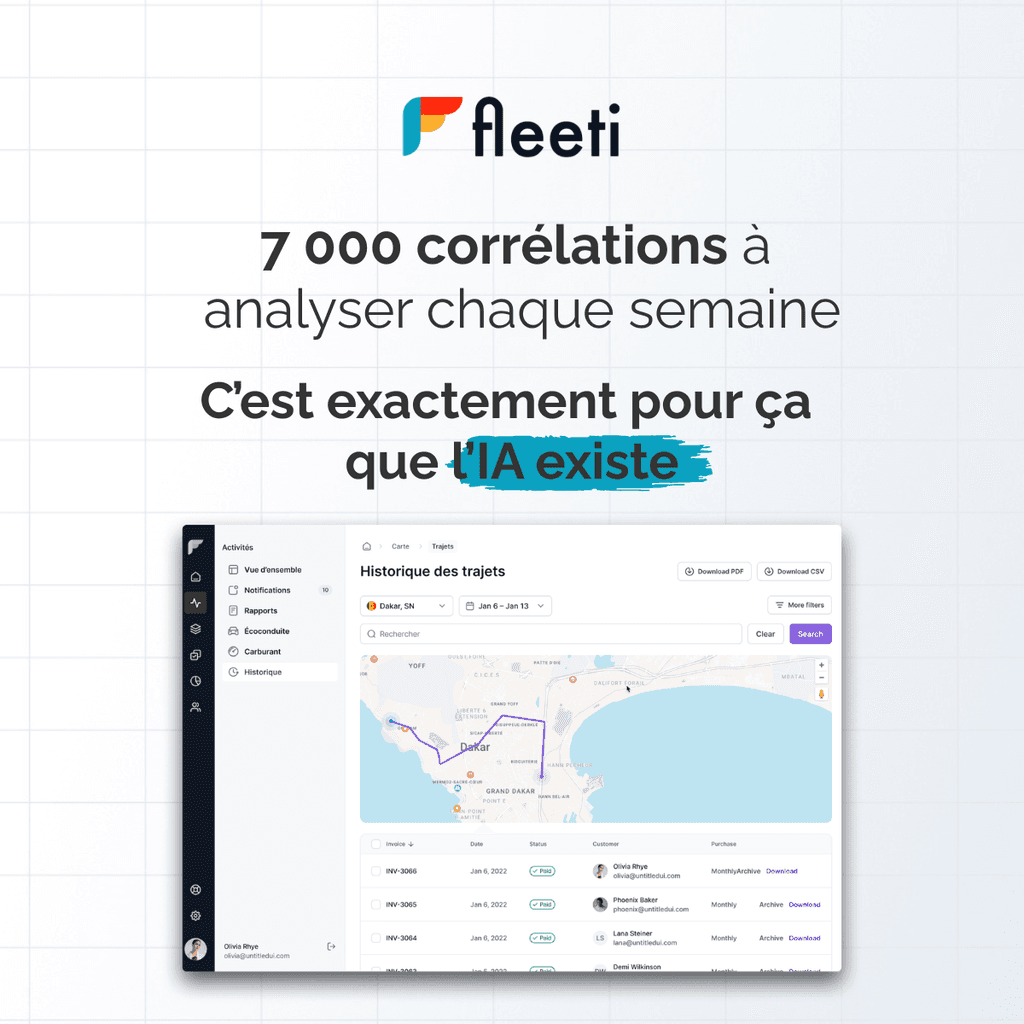
When people talk about artificial intelligence, they instinctively think of customer service chatbots, e-commerce recommendation algorithms or facial recognition. Visible applications, often aimed at consumers, that make the headlines. Meanwhile, one of the most powerful use cases for AI remains largely invisible, because it is operational rather than spectacular: fleet management. Yet it has exactly the characteristics that artificial intelligence was designed for.
One example is enough to grasp the scale: a fleet of thirty vehicles covering some twenty different routes, with around ten variables to monitor per vehicle, generates several thousand possible combinations to analyse every week. No one can process that volume by hand with the same precision on every line. You inevitably focus on the most obvious cases, and subtle anomalies carry on for months without being detected.
Why is fleet management a natural use case for AI?
Fleet management is a natural use case for AI because every vehicle continuously produces data that varies with the driver, the load, the road, the weather and the mechanical condition. Detecting an anomaly means cross-referencing all these variables and comparing each vehicle with the others: a volume that manual analysis cannot absorb.
Kilometres driven, litres consumed, journey time, number of stops, reported incidents: connected vehicle data comes in every day. To spot what genuinely falls outside the statistical norm, you need to put it side by side and compare each vehicle with those operating in similar conditions.
Take a fleet of twenty-five vehicles. Every week, you receive the consumption readings. Three of them have a problem that is only just starting to show: discreet fuel theft, an emerging mechanical overconsumption issue, a regular unbilled detour. Working manually, you will spot the most blatant case. The other two will carry on for months, because they remain in a grey area where the gap is not clear enough to attract attention. This is not a lack of skill; it is a cognitive limit when faced with the volume of information to process.
How does AI detect fuel consumption anomalies?
AI detects fuel consumption anomalies by automatically comparing each vehicle with those of the same generation, on the same routes and with the same loads. Using machine learning, it cross-references the history to isolate the variable at play: a route, a change of driver, or irregular overconsumption that warrants investigation.
The algorithm spots the vehicle whose consumption has never changed even though its load has doubled several times. It flags the one whose behaviour changed at exactly the moment the driver changed. Because a truck that overconsumes can have ten different causes:
A single route at fault: if it only overconsumes on one particular route, the cause is probably traffic conditions.
A single driver at fault: if it overconsumes on every route, but only since a specific driver has been driving it, you have a starting point for your investigation.
No clear correlation: if it overconsumes irregularly, with no link to the route or the driver, something else may be going on.
It is this cross-referencing that reveals the consumption gaps the fuel budget does not show, including discreet fuel theft.
How does AI make predictive maintenance possible?
AI makes predictive maintenance possible by cross-referencing each vehicle’s on-board data to learn to recognise the early warning signs of a failure. It does not replace the mechanic: it shows them where to focus their attention according to the actual level of risk, rather than a theoretical servicing schedule.
Unplanned downtime is expensive: emergency repairs, delivery delays, customer penalties. Yet a fixed schedule does not take actual operating conditions into account. A vehicle driven on poor roads with heavy loads ages faster than one running on tarmac with light loads. Hence the value of preventive maintenance guided by each vehicle’s data.
What concrete gains does AI bring to a fleet?
The first gain from AI in fleet management is making visible losses that used to go unnoticed: on an average fleet, the few vehicles identified often account for several percentage points of overconsumption. That is sometimes the difference between a profitable route and one that loses money without anyone knowing why.
The second gain concerns breakdowns and vehicle downtime days. The cost of an unplanned breakdown far exceeds that of the repair itself: it is the knock-on effect on subsequent deliveries, contractual penalties and the urgent reassignment of another vehicle that really weighs on profitability. AI does not modernise fleet management: it shifts attention away from constant emergencies towards structural causes.
What are the limits of AI in vehicle fleet management?
The main limit of AI in fleet management is that it detects correlations without understanding their cause. It flags that a truck has been overconsuming for several weeks, but does not know whether the road has deteriorated, whether the driver is avoiding a problem or whether fuel is being diverted. This on-the-ground context does not exist in any database.
That context lies in the minds of the fleet manager, the driver and those who know the terrain and its real constraints. Likewise, an optimisation algorithm can calculate that the shortest route goes via a particular road. But it knows nothing of the operational constraints that make it impassable at certain times, the customers with fixed delivery windows, or the trade-offs between logistical efficiency and the customer relationship.
These decisions cannot be calculated: they are negotiated, taking into account parameters that are never formalised anywhere. AI works well on repetitive, measurable patterns. It fails as soon as it has to interpret the unspoken, handle the exception or choose between conflicting priorities.
The right approach is therefore to use it in your fleet management software as an alert system, not as an autopilot. It shows you where to dig; it is up to the fleet manager to decide what to do with what they find.
Where should you start to use AI in your fleet management?
To use AI in your fleet management, you need to start by structuring data collection, not by choosing an algorithm. AI does not create telematics data where there is none: it amplifies what already exists, for better or for worse. The real starting point is organisational, not technical.
Many transport companies understand the value of AI for optimising their fleet, but stumble over a practical question: how do you get started when information is scattered across logbooks, Excel files on different computers, handwritten records and verbal exchanges between the fleet supervisor and the drivers? This is often the moment to move from Excel files to fleet management software.
Before talking about algorithms, ask yourself a simple question: do you know, for each vehicle and each day, how many kilometres were driven, how many litres were consumed, which incidents were reported and which delays occurred? If this information takes several days to come in and arrives in scattered formats, the AI will be spinning its wheels on incomplete or outdated data.
Solutions such as Fleeti start from this observation. Before deploying fleet management AI, you need to put in place the means to collect, centralise and make accessible the basic information on your rolling assets: a mileage reading at departure and arrival, fuel cost tracking at every fill-up, and reporting of every incident. This data may be imperfect, entered by hand, with the occasional error. What matters is that it exists, that it circulates and that it can be accessed quickly. Only once this foundation is in place does AI come into its own.
What drives AI performance in fleet management?
It is not the algorithm that drives AI performance in fleet management, but the quality of the data it is given. Artificial intelligence is designed for environments where variables are numerous, unstable and hard to analyse manually. Fleet management is one of them, but AI cannot create something out of nothing.
That does not mean it is reserved for highly digitalised environments that have already automated everything. However, a fleet manager who does not know today how many litres each vehicle consumes, or where their maintenance costs are going, will get nothing out of an algorithm. Performance comes first from the data, not from the tool.
Companies that have structured their data collection have a real head start. They see what others cannot, correct things before they become costly and anticipate where others are left to react.
This is exactly what the Fleeti platform, which brings together telematics and fleet management, helps you build: a reliable, accessible and usable database, so that artificial intelligence can finally do its job.
What does artificial intelligence change in fleet management?
Artificial intelligence changes fleet management by continuously analysing each vehicle’s data to spot what a human cannot see: consumption anomalies, discreet fuel theft, early warning signs of a breakdown. It does not replace the fleet manager: it flags where to dig, and is only as good as the quality of the data collected.