
AI for fleet management: your copilot for faster decisions
AI for fleet management: your copilot for faster decisions
AI for fleet management: your copilot for faster decisions
Fleeti is AI fleet management software that answers your questions in plain language, detects overruns before they affect your TCO, recommends actions and automates recurring tasks. Artificial intelligence that supports your decisions, without changing tools or exposing your data.
Fleeti is AI fleet management software that answers your questions in plain language, detects overruns before they affect your TCO, recommends actions and automates recurring tasks. Artificial intelligence that supports your decisions, without changing tools or exposing your data.
Book a demo

AI for fleet management: your copilot for faster decisions
Fleeti is AI fleet management software that answers your questions in plain language, detects overruns before they affect your TCO, recommends actions and automates recurring tasks. Artificial intelligence that supports your decisions, without changing tools or exposing your data.
Book a demo
Ask questions in plain language and get a reasoned answer
Ask questions in plain language and get a reasoned answer
Ask questions in plain language and get a reasoned answer
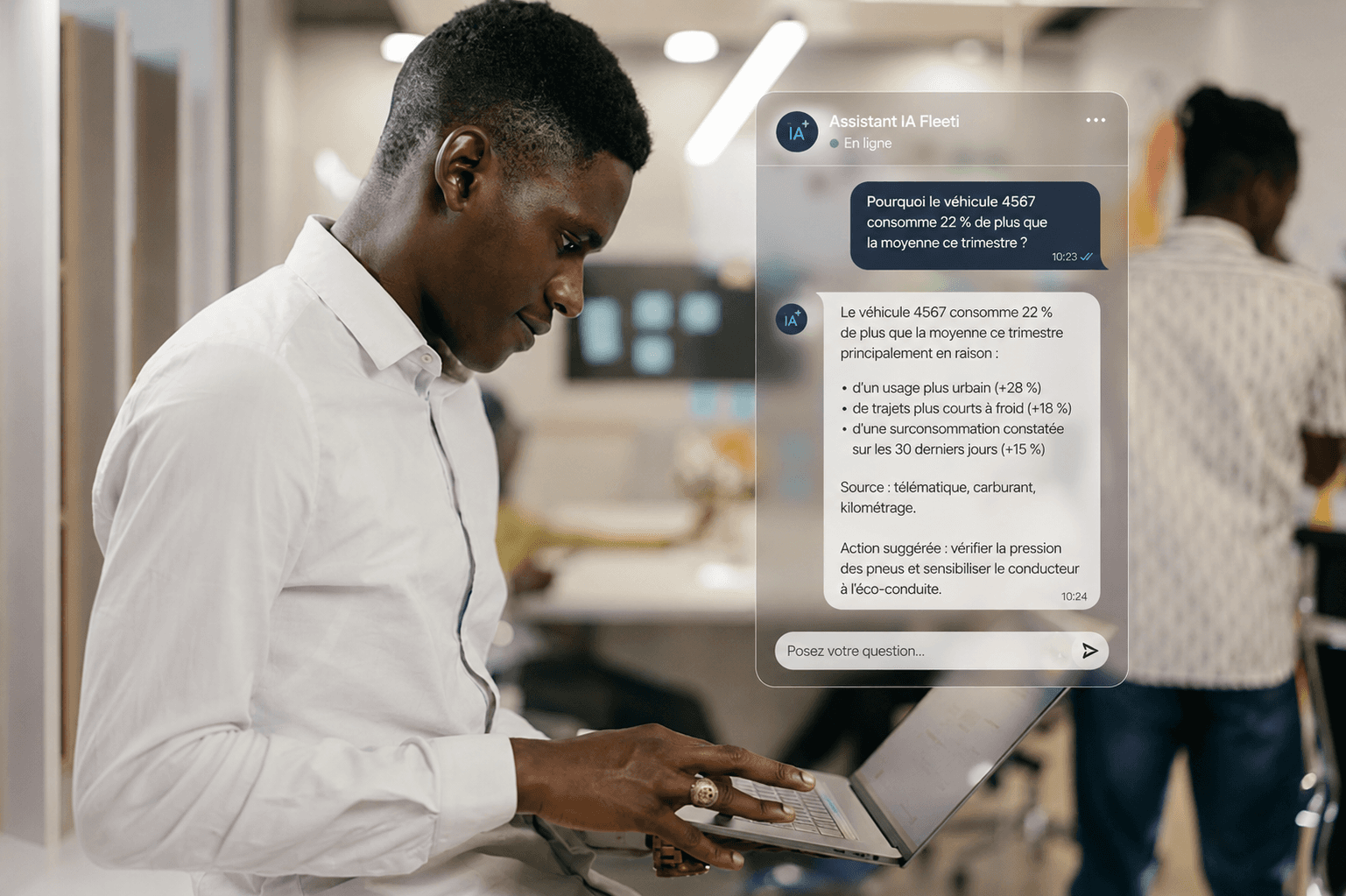
Ask your fleet questions the way you would ask a colleague: “Why is vehicle 4567 using 22% more fuel than average this quarter?”, “Which drivers are exceeding their contractual mileage?”, “What is the cost per kilometre by site this month?”.
Ask your fleet questions the way you would ask a colleague: “Why is vehicle 4567 using 22% more fuel than average this quarter?”, “Which drivers are exceeding their contractual mileage?”, “What is the cost per kilometre by site this month?”.
The AI assistant cross-checks your data in seconds and answers with cited sources and a suggested action ready to launch. No pre-written procedures, no static knowledge base: the answer reflects the actual state of your fleet at the moment you ask.
The AI assistant cross-checks your data in seconds and answers with cited sources and a suggested action ready to launch. No pre-written procedures, no static knowledge base: the answer reflects the actual state of your fleet at the moment you ask.
Available to fleet managers, CFOs and CSR managers, with access levels configurable by user profile according to your internal governance rules.
Available to fleet managers, CFOs and CSR managers, with access levels configurable by user profile according to your internal governance rules.
Automatic anomaly detection across all your data
Automatic anomaly detection across all your data
Automatic anomaly detection across all your data
Fleeti AI continuously scans your telematics data, fuel cards, lease contracts, claims and supplier payments.
Fleeti AI continuously scans your telematics data, fuel cards, lease contracts, claims and supplier payments.
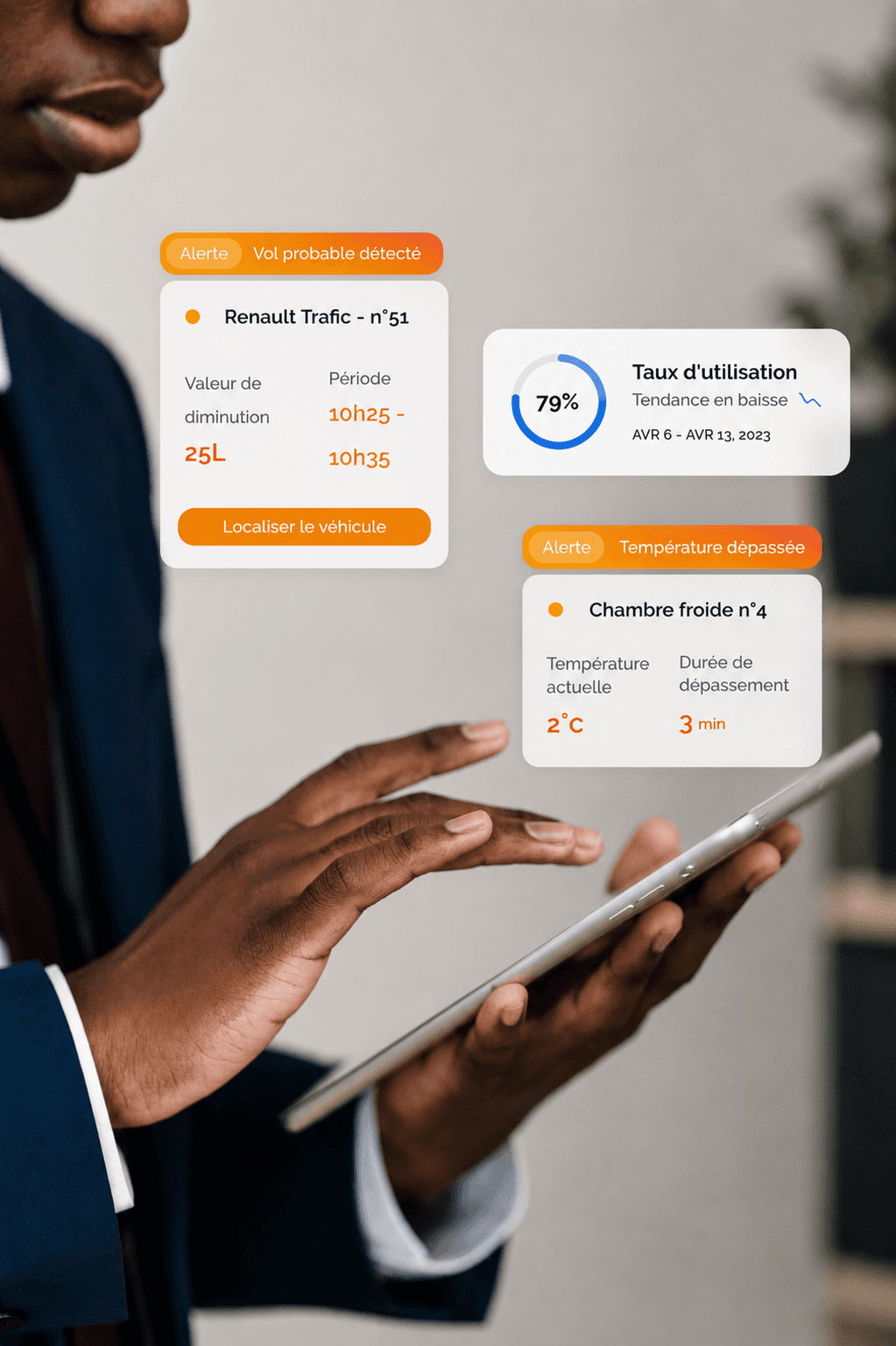
It identifies anomalies the eye would miss: excess fuel use, suspicious refuels, contract overruns, double billing and drift in cost per kilometre. Each anomaly is ranked by severity and quantified in terms of TCO impact.
It identifies anomalies the eye would miss: excess fuel use, suspicious refuels, contract overruns, double billing and drift in cost per kilometre. Each anomaly is ranked by severity and quantified in terms of TCO impact.
Signals are reported within seconds of detection, by email, on your dashboard or via webhook to your existing tools (Slack, Teams, ERP).
Signals are reported within seconds of detection, by email, on your dashboard or via webhook to your existing tools (Slack, Teams, ERP).
Costed recommendations for you to decide on, never imposed
Costed recommendations for you to decide on, never imposed
Costed recommendations for you to decide on, never imposed
For each overrun identified, the AI proposes a concrete action, quantifies the expected saving and logs the decision.
For each overrun identified, the AI proposes a concrete action, quantifies the expected saving and logs the decision.
Reassign an under-used vehicle, renegotiate a lease, move a driver to an electric model, adjust a fuel threshold: you approve or reject. The AI prepares; your teams decide.
Reassign an under-used vehicle, renegotiate a lease, move a driver to an electric model, adjust a fuel threshold: you approve or reject. The AI prepares; your teams decide.
Each recommendation comes with its reasoning: data sources used, assumptions made and sensitivity of the calculation. You decide with no black box.
Each recommendation comes with its reasoning: data sources used, assumptions made and sensitivity of the calculation. You decide with no black box.

Automate the recurring tasks that take up your time
Automate the recurring tasks that take up your time
Automate the recurring tasks that take up your time
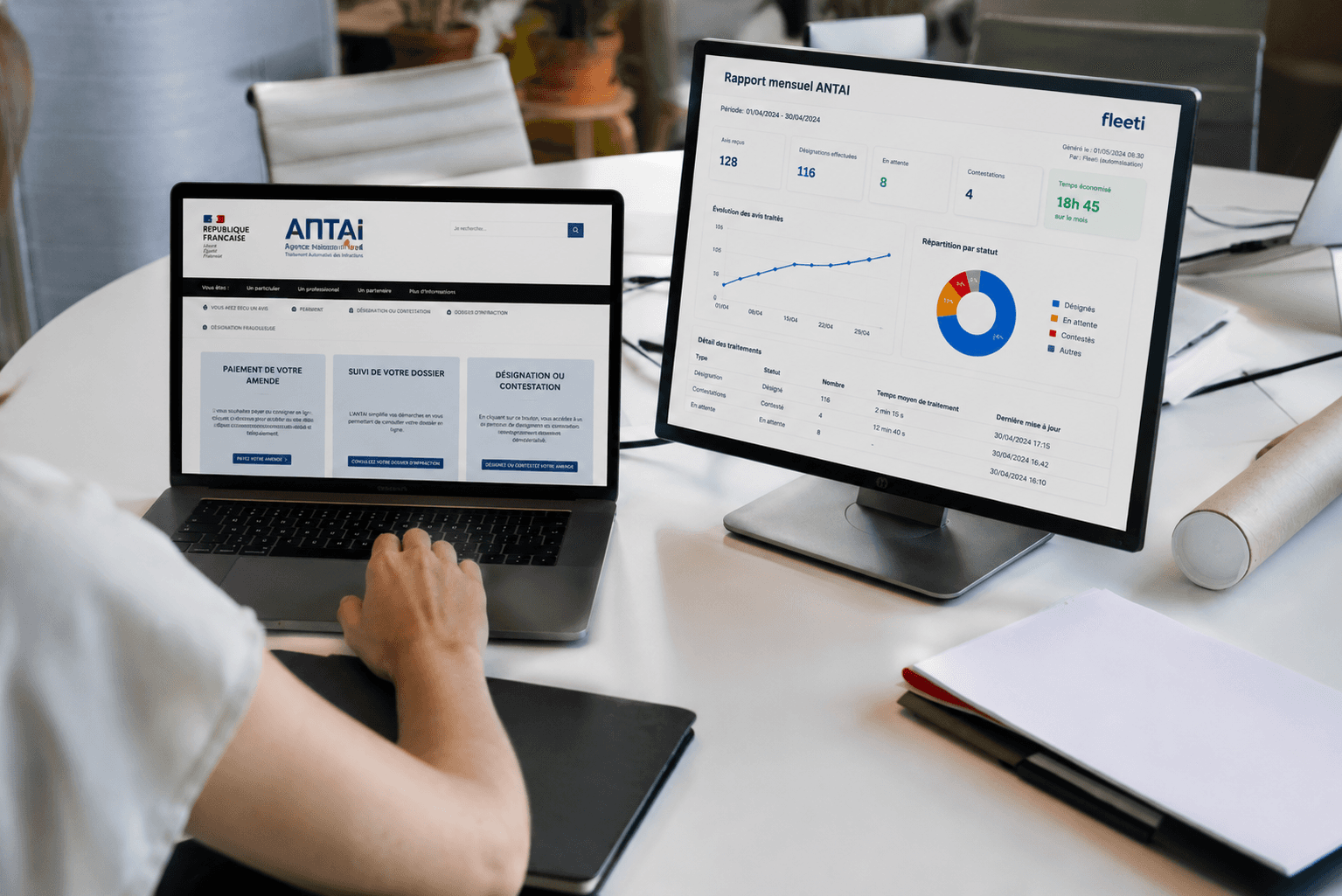
Monthly management reports, servicing reminders, ANTAI designations within the deadline, payroll exports for benefits in kind, contract renewal tracking: the AI prepares the deliverables, applies your rules and submits the final version to you.
Monthly management reports, servicing reminders, ANTAI designations within the deadline, payroll exports for benefits in kind, contract renewal tracking: the AI prepares the deliverables, applies your rules and submits the final version to you.
You approve or correct. Your time goes on high-value decisions instead of paperwork.
You approve or correct. Your time goes on high-value decisions instead of paperwork.
Automations are configurable by user profile and schedule. A full audit trail is kept for every action triggered by the AI.
Automations are configurable by user profile and schedule. A full audit trail is kept for every action triggered by the AI.
AI under control: your data stays yours
AI under control: your data stays yours
AI under control: your data stays yours
Hosted in Europe, AES-256 encryption in transit and at rest, GDPR compliance and alignment with the EU AI Act, which came into application in 2024-2025.
Hosted in Europe, AES-256 encryption in transit and at rest, GDPR compliance and alignment with the EU AI Act, which came into application in 2024-2025.
Your data is not used to train external models. Every automated action is logged, and none is executed without approval from a member of your team according to your governance rules.
Your data is not used to train external models. Every automated action is logged, and none is executed without approval from a member of your team according to your governance rules.
Privacy mode available outside drivers' working hours, in line with CNIL recommendations on company vehicle tracking.
Privacy mode available outside drivers' working hours, in line with CNIL recommendations on company vehicle tracking.

Book a demo
The measured impact of AI in fleet management
The measured impact of AI in fleet management
The measured impact of AI in fleet management

3 hours
3 hours
3 hours
Average time saved each month per fleet manager on reporting and data consolidation, observed on fleets using AI.
Average time saved each month per fleet manager on reporting and data consolidation, observed on fleets using AI.
up to 30%
up to 30%
up to 30%
Observed TCO reduction in the first year of using AI for fleet management, mainly on fuel, maintenance and claims.
Observed TCO reduction in the first year of using AI for fleet management, mainly on fuel, maintenance and claims.
Observed TCO reduction in the first year of using AI for fleet management, mainly on fuel, maintenance and claims.
2 100 €
2 100 €
2 100 €
Average savings per vehicle per year observed on fleets using AI, combining anomaly detection, optimisation recommendations and task automation.
Average savings per vehicle per year observed on fleets using AI, combining anomaly detection, optimisation recommendations and task automation.
Average savings per vehicle per year observed on fleets using AI, combining anomaly detection, optimisation recommendations and task automation.
24h/24
24h/24
24h/24
Continuous AI data monitoring: telematics feeds, fuel cards, contracts and IoT sensors scanned around the clock, without interruption.
Continuous AI data monitoring: telematics feeds, fuel cards, contracts and IoT sensors scanned around the clock, without interruption.
Continuous AI data monitoring: telematics feeds, fuel cards, contracts and IoT sensors scanned around the clock, without interruption.
5 minutes
5 minutes
5 minutes
Average time to get a first usable analysis on a connected fleet, with no prior setup or manual data entry.
Average time to get a first usable analysis on a connected fleet, with no prior setup or manual data entry.
Average time to get a first usable analysis on a connected fleet, with no prior setup or manual data entry.
10+ sources
10+ sources
10+ sources
Data sources cross-checked simultaneously by Fleeti AI: telematics, OEM, fuel cards, ANTAI, contracts, claims, IoT sensors, payments, calendars and vehicle records.
Data sources cross-checked simultaneously by Fleeti AI: telematics, OEM, fuel cards, ANTAI, contracts, claims, IoT sensors, payments, calendars and vehicle records.
Data sources cross-checked simultaneously by Fleeti AI: telematics, OEM, fuel cards, ANTAI, contracts, claims, IoT sensors, payments, calendars and vehicle records.
100 %
100 %
100 %
Share of automated actions submitted for human approval before execution. No high-impact decision is made without your explicit approval.
Share of automated actions submitted for human approval before execution. No high-impact decision is made without your explicit approval.
Share of automated actions submitted for human approval before execution. No high-impact decision is made without your explicit approval.
How Fleeti AI works in practice
The AI does not replace your teams. It sits between your data and your decisions to surface the right questions, put figures on trade-offs and prepare actions. Its daily work follows four steps.
01
01
Continuous data collection
Continuous data collection
Continuous data collection
The AI is connected to all your sources: telematics devices, manufacturer APIs, fuel cards, ANTAI, lease contracts, IoT sensors and accounting. No manual entry, no re-entry.
The AI is connected to all your sources: telematics devices, manufacturer APIs, fuel cards, ANTAI, lease contracts, IoT sensors and accounting. No manual entry, no re-entry.
The AI is connected to all your sources: telematics devices, manufacturer APIs, fuel cards, ANTAI, lease contracts, IoT sensors and accounting. No manual entry, no re-entry.
02
02
Analysis and signal detection
Analysis and signal detection
Analysis and signal detection
Data cross-checked in near real time to identify anomalies, deviations from contracts or history, and quantifiable optimisation opportunities.
Data cross-checked in near real time to identify anomalies, deviations from contracts or history, and quantifiable optimisation opportunities.
Data cross-checked in near real time to identify anomalies, deviations from contracts or history, and quantifiable optimisation opportunities.
03
03
Costed action recommendation
Costed action recommendation
Costed action recommendation
For each signal detected, the AI proposes a concrete action, quantifies the expected saving and sets out the context so you can make an informed decision.
For each signal detected, the AI proposes a concrete action, quantifies the expected saving and sets out the context so you can make an informed decision.
For each signal detected, the AI proposes a concrete action, quantifies the expected saving and sets out the context so you can make an informed decision.
04
04
Human approval and logged execution
Human approval and logged execution
Human approval and logged execution
Your teams approve, edit or reject. Every decision is logged and kept for audit. The AI learns from your approvals to refine its next recommendations.
Your teams approve, edit or reject. Every decision is logged and kept for audit. The AI learns from your approvals to refine its next recommendations.
Your teams approve, edit or reject. Every decision is logged and kept for audit. The AI learns from your approvals to refine its next recommendations.
Three types of questions managers ask every day
Questions vary by role and time of month. Three families of questions stand out among Fleeti AI users.
Operational management
Operational management
Operational management
“Which vehicles are over their mileage quota?” / “Which drivers have the most at-fault claims over 12 months?” / “Which services are overdue this month?”
“Which vehicles are over their mileage quota?” / “Which drivers have the most at-fault claims over 12 months?” / “Which services are overdue this month?”
“Which vehicles are over their mileage quota?” / “Which drivers have the most at-fault claims over 12 months?” / “Which services are overdue this month?”
For fleet managers, day to day.
For fleet managers, day to day.
For fleet managers, day to day.
Financial management
Financial management
Financial management
“What is the cost per kilometre by site over 6 months?” / “Which TCO overruns this quarter, and why?” / “Which powertrain is most cost-effective for this usage profile?”
“What is the cost per kilometre by site over 6 months?” / “Which TCO overruns this quarter, and why?” / “Which powertrain is most cost-effective for this usage profile?”
“What is the cost per kilometre by site over 6 months?” / “Which TCO overruns this quarter, and why?” / “Which powertrain is most cost-effective for this usage profile?”
For CFOs and management controllers.
For CFOs and management controllers.
For CFOs and management controllers.
Strategic management
Strategic management
Strategic management
“Which drivers could switch to electric with no extra running cost?” / “Where do we stand on our LOM law quota?” / “What were CO2 emissions by site over the past year?”
“Which drivers could switch to electric with no extra running cost?” / “Where do we stand on our LOM law quota?” / “What were CO2 emissions by site over the past year?”
“Which drivers could switch to electric with no extra running cost?” / “Where do we stand on our LOM law quota?” / “What were CO2 emissions by site over the past year?”
For senior management, CSR and the executive committee.
For senior management, CSR and the executive committee.
For senior management, CSR and the executive committee.
Six concrete AI use cases in fleet management
Fleeti AI answers precise questions rather than vague intentions. Here are six concrete examples where it delivers a usable answer in seconds, based on your fleet's real data.
01. Detecting excess fuel use
01. Detecting excess fuel use
“Why is this vehicle using more fuel?” The AI cross-checks reported consumption, actual mileage, trip profile, driving behaviour and maintenance history. It isolates the gap attributable to each factor and quantifies the potential saving.
02. Electric eligibility by vehicle
“Which drivers can switch to electric with no extra running cost?” The AI analyses daily mileage, trip profiles, stop durations and charging options. It produces a costed list ready for decision.
03. Detecting suspicious refuels and fraud
The AI scans fuel and toll transactions, cross-checks location and working hours, and flags anomalies: refuel exceeding tank capacity, out-of-hours refuel, double toll charge, unusual amount.
04. Real-time TCO drift
Instead of waiting for monthly consolidation, the AI alerts you as soon as a cost item deviates from its planned path: energy, maintenance, insurance, claims. Each overrun is attributed to its likely cause, with a link to the TCO tracking page for details.
05. Automatic preparation of ANTAI designations
For each offence received, the AI cross-checks location, vehicle assignment and driver schedule, suggests the driver responsible and prepares the designation within the 45-day legal deadline. Your teams approve in one click.
06. Predictive maintenance and workshop planning
Using actual mileage, engine hours and fault codes from devices and manufacturer APIs, the AI anticipates the jobs needed and smooths out workshop workload. See our Preventive Maintenance page for details.
What data Fleeti AI uses
The relevance of fleet management AI depends directly on how rich its data is. Fleeti AI cross-checks four main families of sources, with no manual entry or re-entry.
Telematics and IoT sensors
Fleeti devices and sensors installed on vehicles, machinery and equipment. Location, speed, engine hours, driving behaviour, fault codes, temperatures.
Manufacturer API (OEM)
Direct connection with partner manufacturers for recent vehicles: odometer, battery level, range, state of charge. No hardware installation.
Fuel and energy cards
Transactions from the main providers: fuel, EV charging, toll tags. Each transaction is matched to the vehicle and driver, with no manual entry.
Contracts, ANTAI and accounting
ANTAI connection for offences, automatic import of leasing and insurance contracts, and integration with accounting and payroll tools for consolidated TCO tracking, benefits in kind and French company vehicle taxes (TVS, TAI).
Frequently asked questions about AI in fleet management
Services, construction, transport, industrial fleet management : teams managing high operating costs and risks are the first to adopt it. Fleet management AI is an operational tool available today, not a future gimmick. Fleeti puts AI at the service of your decisions rather than in place of your teams. Your data stays yours, and so do your decisions.
Services, construction, transport, industrial fleet management : teams managing high operating costs and risks are the first to adopt it. Fleet management AI is an operational tool available today, not a future gimmick. Fleeti puts AI at the service of your decisions rather than in place of your teams. Your data stays yours, and so do your decisions.
Book a demo

IoT for the operations of African and European businesses.


© 2026 Fleeti SAS