
Electric fleet transition: manage it calmly, vehicle by vehicle
Electric fleet transition: manage it calmly, vehicle by vehicle
Electric fleet transition: manage it calmly, vehicle by vehicle
For businesses, the electric fleet transition is now a question of "how" rather than "if". Decide vehicle by vehicle, secure your LOM law compliance, control TCO over ten years and bring your teams along: here is the approach Fleeti offers to electrify your fleet with no operational disruption.
For businesses, the electric fleet transition is now a question of "how" rather than "if". Decide vehicle by vehicle, secure your LOM law compliance, control TCO over ten years and bring your teams along: here is the approach Fleeti offers to electrify your fleet with no operational disruption.
Book a demo

Electric fleet transition: manage it calmly, vehicle by vehicle
For businesses, the electric fleet transition is now a question of "how" rather than "if". Decide vehicle by vehicle, secure your LOM law compliance, control TCO over ten years and bring your teams along: here is the approach Fleeti offers to electrify your fleet with no operational disruption.
Book a demo
Decide vehicle by vehicle, based on actual use
Decide vehicle by vehicle, based on actual use
Decide vehicle by vehicle, based on actual use
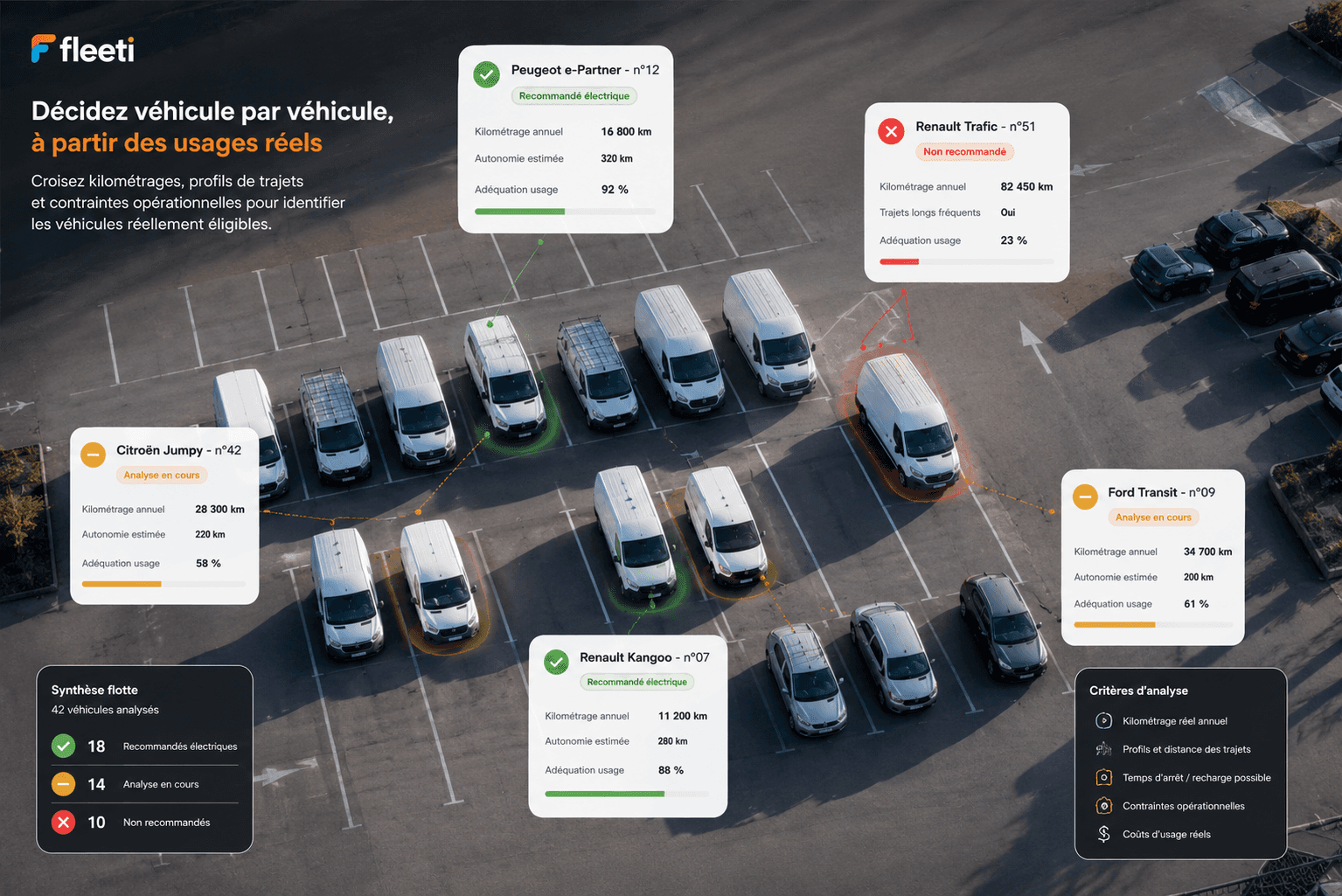
The switch to an electric fleet happens vehicle by vehicle.
The switch to an electric fleet happens vehicle by vehicle.
Cross-check actual mileage, trip profiles and operational constraints to measure electric eligibility fleet by fleet and segment by segment, and identify the vehicles that can genuinely switch.
Cross-check actual mileage, trip profiles and operational constraints to measure electric eligibility fleet by fleet and segment by segment, and identify the vehicles that can genuinely switch.
No risk of operational failure from badly replacing a vehicle that does 80,000 km a year: the decision rests on field data, not statistical averages.
No risk of operational failure from badly replacing a vehicle that does 80,000 km a year: the decision rests on field data, not statistical averages.

Secure your LOM law compliance
Secure your LOM law compliance
Secure your LOM law compliance
France's LOM law and the new annual incentive tax (TAI) require increasing fleet greening: 15% low-emission vehicles in 2026, 40% in 2027 and 70% in 2030 for fleets of more than 100 light vehicles at companies with more than 50 employees.
France's LOM law and the new annual incentive tax (TAI) require increasing fleet greening: 15% low-emission vehicles in 2026, 40% in 2027 and 70% in 2030 for fleets of more than 100 light vehicles at companies with more than 50 employees.
Track your LOM greening quotas in real time and anticipate the penalty schedule (€2,000 per missing vehicle in 2026, €5,000 in 2028, capped at 1% of French turnover) rather than facing it when it lands.
Track your LOM greening quotas in real time and anticipate the penalty schedule (€2,000 per missing vehicle in 2026, €5,000 in 2028, capped at 1% of French turnover) rather than facing it when it lands.
Annual reporting becomes a structured, defensible deliverable instead of a last-minute rush.
Annual reporting becomes a structured, defensible deliverable instead of a last-minute rush.
Control TCO along the whole pathway
Control TCO along the whole pathway
Control TCO along the whole pathway
An electric vehicle is about more than its monthly lease.
An electric vehicle is about more than its monthly lease.
Continuously compare combustion with the electric equivalent, including the EV bonus, tax (70% benefit-in-kind allowance for clean vehicles, capped at €4,582 until 31 December 2027, and the incentive tax), charging costs, residual value and maintenance. For most uses, a business EV's TCO becomes comparable to combustion.
Continuously compare combustion with the electric equivalent, including the EV bonus, tax (70% benefit-in-kind allowance for clean vehicles, capped at €4,582 until 31 December 2027, and the incentive tax), charging costs, residual value and maintenance. For most uses, a business EV's TCO becomes comparable to combustion.
Your decisions become defensible to your finance team, model by model and year by year.
Your decisions become defensible to your finance team, model by model and year by year.
Manage charging with no operational disruption
Manage charging with no operational disruption
Manage charging with no operational disruption
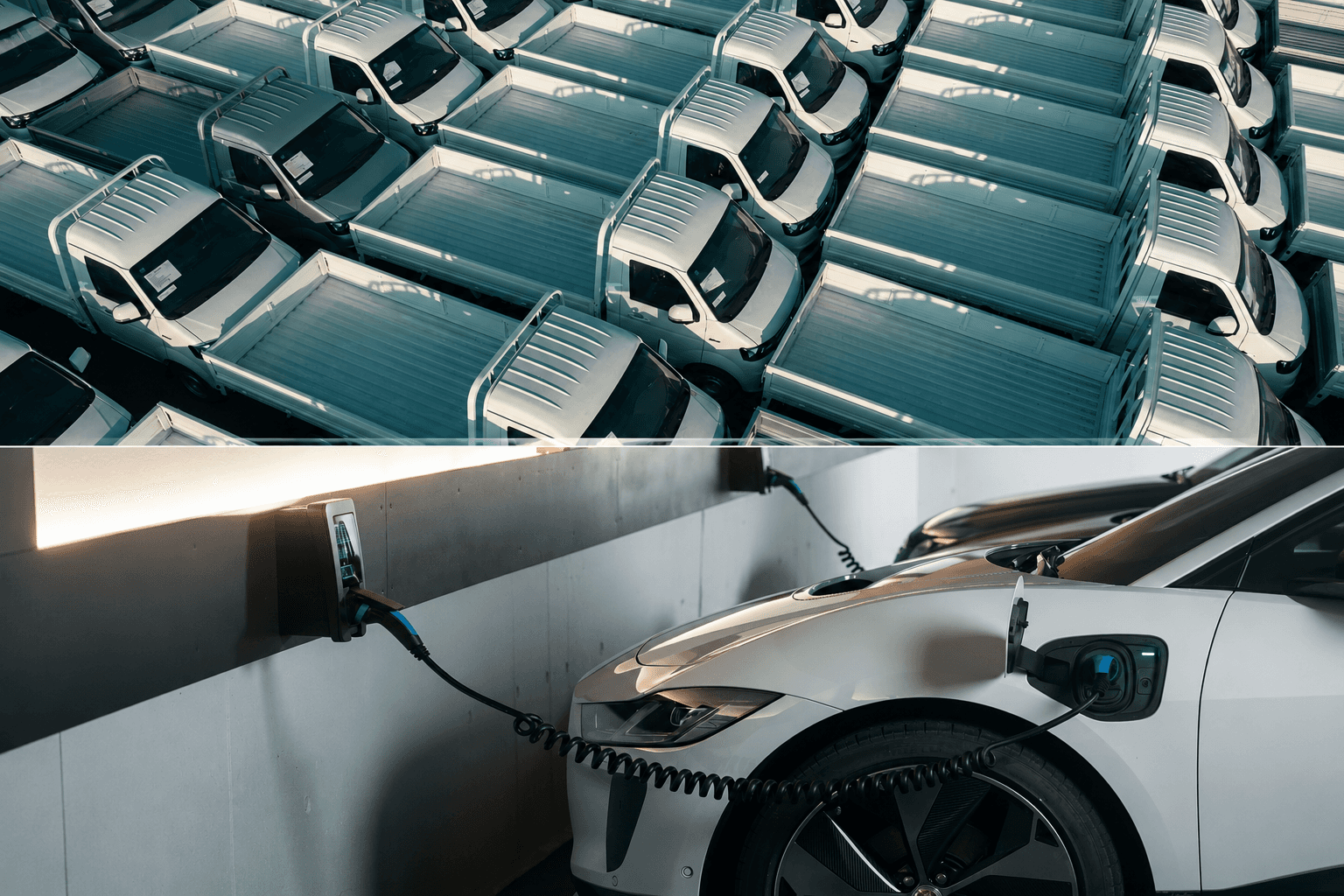
Range stops being an obstacle once it is planned for.
Range stops being an obstacle once it is planned for.
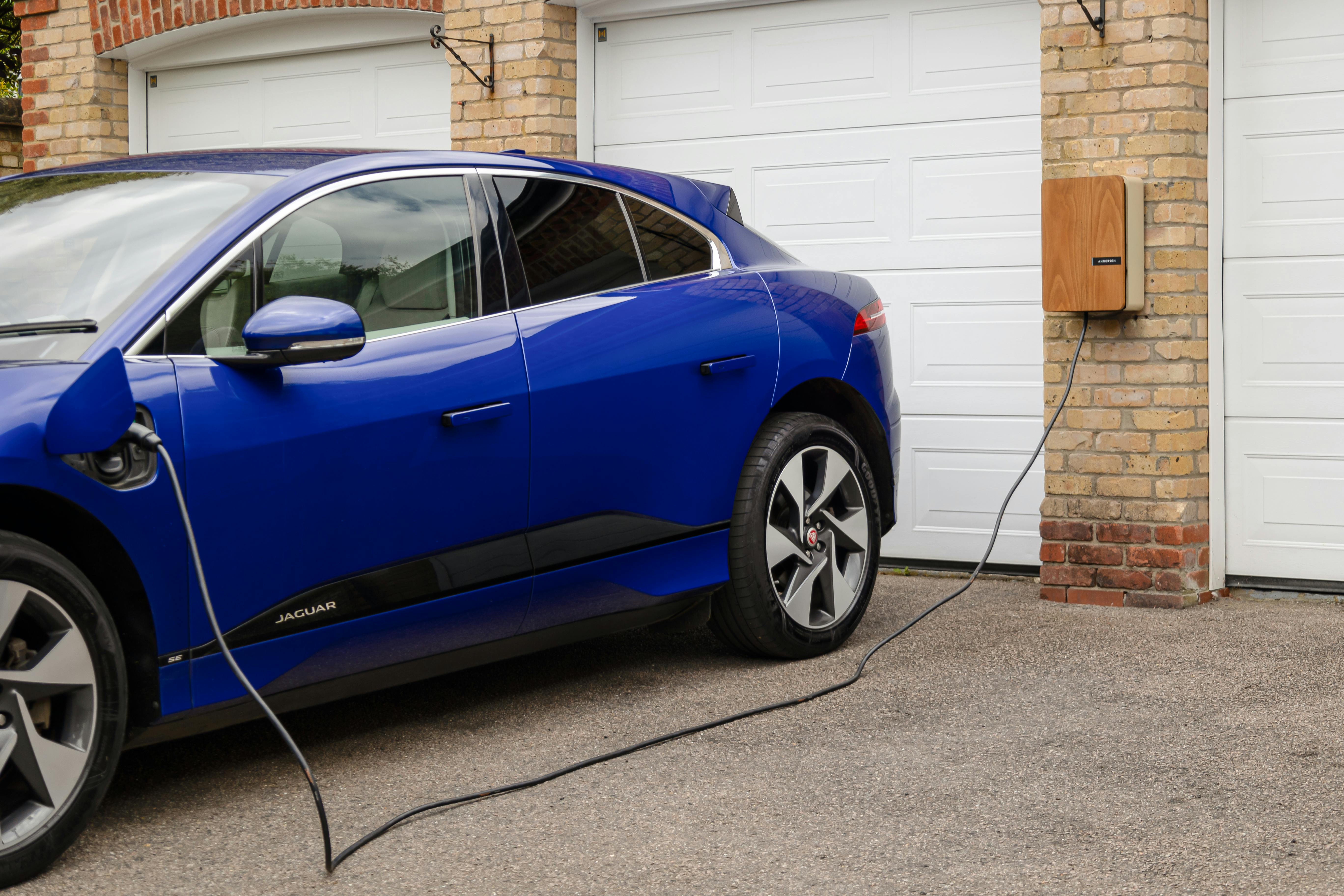
Track each vehicle's state of charge, organise on-site, home and on-the-road charging, and reimburse drivers for home charging.
Track each vehicle's state of charge, organise on-site, home and on-the-road charging, and reimburse drivers for home charging.
Coordinate installations with your charger and charging card partners, without multiplying tools or re-entry.
Coordinate installations with your charger and charging card partners, without multiplying tools or re-entry.
Bring your teams and drivers along
Bring your teams and drivers along
Electrifying a fleet is a change management project rather than an IT project.
Electrifying a fleet is a change management project rather than an IT project.
Electrifying a fleet is a change management project rather than an IT project.
Car policy overhaul, internal communication, driver training and gradual support through the transition.
Car policy overhaul, internal communication, driver training and gradual support through the transition.
Car policy overhaul, internal communication, driver training and gradual support through the transition.
A gradual pathway rather than a big bang. Every employee finds their place in the process, with no drop in service quality.
A gradual pathway rather than a big bang. Every employee finds their place in the process, with no drop in service quality.
A gradual pathway rather than a big bang. Every employee finds their place in the process, with no drop in service quality.

Book a demo
Three figures that put the transition in perspective for your business
Three figures that put the transition in perspective for your business
Three figures that put the transition in perspective for your business

70 %
70 %
70 %
Share of low-emission vehicles the LOM law will require for fleets of more than 100 vehicles by 2030. The interim milestones (20% in 2024, 40% in 2027) leave no room for waiting.
Share of low-emission vehicles the LOM law will require for fleets of more than 100 vehicles by 2030. The interim milestones (20% in 2024, 40% in 2027) leave no room for waiting.
60 %
60 %
60 %
Share of European business vans whose actual use is already compatible with an electric equivalent, according to available industry telematics analyses. Most fleets underestimate their potential.
Share of European business vans whose actual use is already compatible with an electric equivalent, according to available industry telematics analyses. Most fleets underestimate their potential.
Share of European business vans whose actual use is already compatible with an electric equivalent, according to available industry telematics analyses. Most fleets underestimate their potential.
2 000 €
2 000 €
2 000 €
Annual incentive tax (TAI) due in 2026 per missing vehicle for fleets of more than 100 light vehicles that miss their greening quota. The rate rises to €4,000 in 2027 and €5,000 in 2028, capped at 1% of French turnover. The financial risk far exceeds the cost of a managed transition.
Annual incentive tax (TAI) due in 2026 per missing vehicle for fleets of more than 100 light vehicles that miss their greening quota. The rate rises to €4,000 in 2027 and €5,000 in 2028, capped at 1% of French turnover. The financial risk far exceeds the cost of a managed transition.
Annual incentive tax (TAI) due in 2026 per missing vehicle for fleets of more than 100 light vehicles that miss their greening quota. The rate rises to €4,000 in 2027 and €5,000 in 2028, capped at 1% of French turnover. The financial risk far exceeds the cost of a managed transition.
Our four-step approach to electrifying your fleet
How do you electrify a fleet without disrupting the business? By breaking it into four auditable steps: vehicle-by-vehicle eligibility audit, TCO-based decision, gradual rollout coordinated with charging, then continuous management. A business fleet's electric transition succeeds when it is run as a company project rather than an opportunistic replacement. Here is the pathway Fleeti builds with you.
01
01
Eligibility audit
Eligibility audit
Eligibility audit
Automatic cross-check of each vehicle's actual usage data (annual mileage, trip profile, stop times, operational constraints) against the range of equivalent electric models. Field data rather than marketing WLTP figures.
Automatic cross-check of each vehicle's actual usage data (annual mileage, trip profile, stop times, operational constraints) against the range of equivalent electric models. Field data rather than marketing WLTP figures.
Automatic cross-check of each vehicle's actual usage data (annual mileage, trip profile, stop times, operational constraints) against the range of equivalent electric models. Field data rather than marketing WLTP figures.
02
02
TCO-based decision
TCO-based decision
TCO-based decision
Combustion vs electric comparison on full TCO over 5 to 7 years, including the EV bonus, tax (benefits in kind, incentive tax), charging costs, maintenance and residual value. Every replacement can be justified to your finance team.
Combustion vs electric comparison on full TCO over 5 to 7 years, including the EV bonus, tax (benefits in kind, incentive tax), charging costs, maintenance and residual value. Every replacement can be justified to your finance team.
Combustion vs electric comparison on full TCO over 5 to 7 years, including the EV bonus, tax (benefits in kind, incentive tax), charging costs, maintenance and residual value. Every replacement can be justified to your finance team.
03
03
Gradual rollout
Gradual rollout
Gradual rollout
Replacement in waves aligned with your contract cycles (leases, purchases), coordination of on-site and home chargers, internal communication and car policy overhaul. The transition follows your company's pace.
Replacement in waves aligned with your contract cycles (leases, purchases), coordination of on-site and home chargers, internal communication and car policy overhaul. The transition follows your company's pace.
Replacement in waves aligned with your contract cycles (leases, purchases), coordination of on-site and home chargers, internal communication and car policy overhaul. The transition follows your company's pace.
04
04
Ongoing management
Ongoing management
Ongoing management
Real-time tracking of range, energy consumption, charging and LOM compliance indicators. CO2 reporting compatible with your CSRD approach (Scopes 1 and 2). You stay in control of the pathway.
Real-time tracking of range, energy consumption, charging and LOM compliance indicators. CO2 reporting compatible with your CSRD approach (Scopes 1 and 2). You stay in control of the pathway.
Real-time tracking of range, energy consumption, charging and LOM compliance indicators. CO2 reporting compatible with your CSRD approach (Scopes 1 and 2). You stay in control of the pathway.
Three fleets, three transition pathways
The electric fleet transition is not run the same way in every industry and country. Usage constraints, vehicle mix and local regulations shape the pathway. Here are three examples.
Field services in France
Field services in France
Field services in France
A maintenance company with 200 vans in the Paris region. Daily trips are mostly urban and suburban, with a daily return to the depot. Nearly two thirds of the vehicles can go electric at the next replacement, with on-site charging and a home charging allowance for mobile technicians.
A maintenance company with 200 vans in the Paris region. Daily trips are mostly urban and suburban, with a daily return to the depot. Nearly two thirds of the vehicles can go electric at the next replacement, with on-site charging and a home charging allowance for mobile technicians.
A maintenance company with 200 vans in the Paris region. Daily trips are mostly urban and suburban, with a daily return to the depot. Nearly two thirds of the vehicles can go electric at the next replacement, with on-site charging and a home charging allowance for mobile technicians.
Fleeti levers: eligibility audit, LOM tracking, charging reimbursement
Fleeti levers: eligibility audit, LOM tracking, charging reimbursement
Fleeti levers: eligibility audit, LOM tracking, charging reimbursement
Construction in France
Construction in France
Construction in France
A construction company with 80 light vehicles (sales staff, site managers) and a separate machinery fleet. About half of the light vehicles are eligible in the short term. Construction machinery remains combustion-powered for now, but consolidated CO2 tracking feeds the ESG reporting required by public-sector clients.
A construction company with 80 light vehicles (sales staff, site managers) and a separate machinery fleet. About half of the light vehicles are eligible in the short term. Construction machinery remains combustion-powered for now, but consolidated CO2 tracking feeds the ESG reporting required by public-sector clients.
A construction company with 80 light vehicles (sales staff, site managers) and a separate machinery fleet. About half of the light vehicles are eligible in the short term. Construction machinery remains combustion-powered for now, but consolidated CO2 tracking feeds the ESG reporting required by public-sector clients.
Fleeti levers: targeted LOM scope, CO2 reporting by site
Fleeti levers: targeted LOM scope, CO2 reporting by site
Fleeti levers: targeted LOM scope, CO2 reporting by site
Countries without a direct LOM requirement
Countries without a direct LOM requirement
Countries without a direct LOM requirement
A French company with subsidiaries in Morocco and Senegal. The transition pathway is driven by the group's CSR commitments rather than a local equivalent of the LOM law. It starts with executive vehicles and urban service fleets, where infrastructure allows.
A French company with subsidiaries in Morocco and Senegal. The transition pathway is driven by the group's CSR commitments rather than a local equivalent of the LOM law. It starts with executive vehicles and urban service fleets, where infrastructure allows.
A French company with subsidiaries in Morocco and Senegal. The transition pathway is driven by the group's CSR commitments rather than a local equivalent of the LOM law. It starts with executive vehicles and urban service fleets, where infrastructure allows.
Fleeti levers: multi-country CO2 reporting, central management
Fleeti levers: multi-country CO2 reporting, central management
Fleeti levers: multi-country CO2 reporting, central management
LOM and incentive tax timeline: what French law expects of your fleet in 2026
France's mobility orientation law (LOM, Law No. 2019-1428 of 24 December 2019) and the annual incentive tax (TAI, articles L.421-99-1 to L.421-99-9 of the tax code, introduced at the end of 2024) require companies with more than 50 employees and a fleet of more than 100 light vehicles to reach a growing share of low-emission vehicles, with a rising financial penalty. Four milestones to know for 2026.
2026: 15% low-emission vehicles, €2,000 incentive tax
2026: 15% low-emission vehicles, €2,000 incentive tax
The first threshold with a financial penalty. The TAI applies to the entire fleet (not just replacements, unlike the former LOM mechanism). €2,000 per missing vehicle for fleets of more than 100 light vehicles at companies with more than 50 employees. Declaration and payment in 2026 for the 2025 financial year.
Cap and consequences beyond the figure
The penalty is capped at 1% of turnover generated in France. Beyond the direct cost, non-compliance can lead to exclusion from public contracts and reputational risk, since annual reporting is public. A managed transition always costs less than three years of accumulated TAI.
2027: 40% and €4,000 incentive tax
The quota rises to 40% low-emission vehicles and the TAI doubles to €4,000 per missing vehicle. For fleets that did not start in 2026, the gap between replacement pace and the obligation inevitably widens.
2028-2030: 70% target, €5,000 incentive tax
2028-2030: 70% target,
€5,000 incentive tax
The maximum TAI rate is reached in 2028: €5,000 per missing vehicle per year. The LOM target of 70% low-emission vehicles is expected by 2030. At that point, almost every light vehicle replacement needs to be low-emission.
Frequently asked questions about the business electric fleet transition
A business electric fleet transition should be managed rather than endured: based on actual use, vehicle by vehicle, step by step. Fleeti gives you the data, method and tool to turn a regulatory constraint into an operational and financial advantage.
A business electric fleet transition should be managed rather than endured: based on actual use, vehicle by vehicle, step by step. Fleeti gives you the data, method and tool to turn a regulatory constraint into an operational and financial advantage.
Book a demo

IoT for the operations of African and European businesses.


© 2026 Fleeti SAS