THE FLEETI BLOG
Fleet management in Senegal and Côte d’Ivoire: the 5 daily challenges fleet managers face
In West Africa, five challenges weigh on fleet managers in Dakar and Abidjan, from visibility over vehicles to making use of data, along with the good practices to address them.

Co-founder and Managing Director
Last updated
AT A GLANCE
The topic: the five daily challenges facing fleet managers in Senegal and Côte d’Ivoire, in West Africa, against a backdrop of dense urban traffic in Dakar and Abidjan, long distances between sites and sometimes unpredictable field operations.
The 5 challenges and how to meet them: visibility over actual vehicle use (usage rules, GPS tracking), driver safety (prevention culture, driving analysis and video telematics), operating costs (fuel monitoring, preventive maintenance based on actual use), multi-site coordination (centralising data) and making use of data (a few key indicators shared with the teams).
With Fleeti: Fleeti, the SaaS fleet management and telematics software founded in 2020 by Iban Olçomendy and Gabriel Delerue, brings field telematics and fleet management together. More than 1,000 clients use it for 40,000 connected vehicles and machines, with local teams in countries including Senegal and Côte d’Ivoire.
In West Africa, in Senegal and Côte d’Ivoire alike, optimised fleet management has become a necessity for companies whose business relies on field operations. In Dakar, in Abidjan and in many operational areas, vehicles are no longer just a means of transport: they determine continuity of service, team safety and economic performance.
A fleet manager’s daily routine is made up of complex trade-offs: a lack of visibility over vehicles, incidents that are hard to anticipate, pressure on operating costs, heightened safety requirements and coordinating teams spread across several sites. These challenges are compounded by local realities: dense urban traffic, long distances between sites, a wide variety of vehicle uses and operational constraints that are sometimes unpredictable.
What are the 5 daily challenges facing fleet managers in Senegal and Côte d’Ivoire?
The five daily challenges facing fleet managers in Senegal and Côte d’Ivoire are a lack of visibility over how vehicles are actually used, driver safety, controlling operating costs, coordinating multi-site operations and turning data into decisions. For each one, there are concrete good practices, from shared usage rules to GPS tracking.
This guide looks at each of these challenges and at the good practices that help address them, in Dakar and Abidjan alike.
Challenge 1: how can you gain visibility over how vehicles are actually used?
To gain visibility over how vehicles are actually used, the fleet manager needs to replace partial, delayed or self-reported information with centralised journey data. In Dakar as in Abidjan, this visibility shows where vehicles really are, how they are being used and whether they are being deployed optimally.
Without it, bad habits gradually set in: unnecessary detours, prolonged stops, non-business use or difficulty piecing together events after an incident. In dense urban settings or across multi-site operations, this lack of transparency makes management much harder.
Good practice: formalise clear rules for vehicle use and make sure drivers understand them. Centralising journey information, even in a basic way, already makes it possible to identify recurring discrepancies.
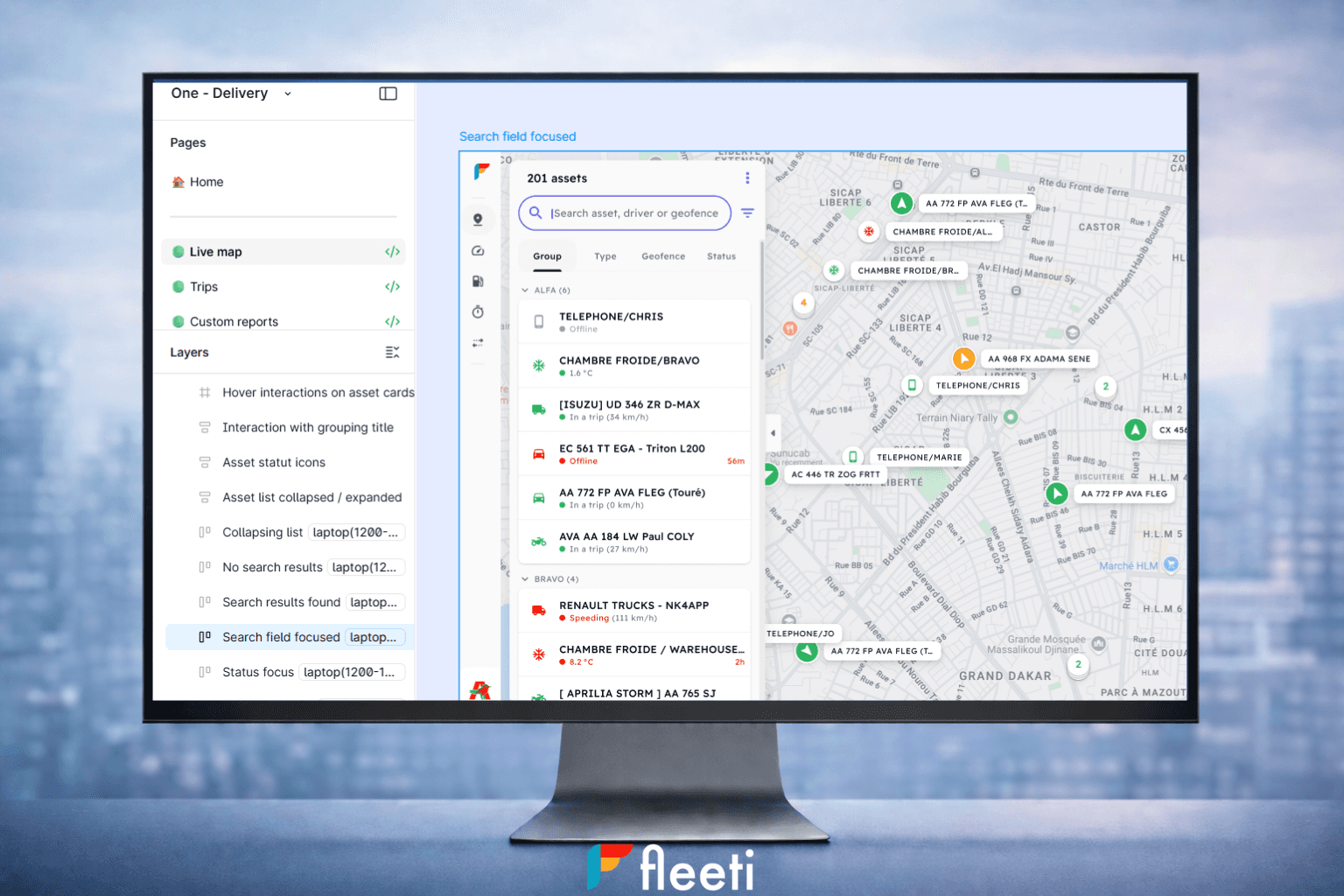
When visibility remains insufficient, GPS tracking becomes a key tool: it provides an objective view of vehicle use and bases the fleet manager’s decisions on facts rather than estimates. GPS tracking solutions such as Fleeti Telematics thus give fleet managers in Senegal and Côte d’Ivoire continuous GPS vehicle tracking, adapted to local realities on the ground.
“Before Fleeti, we only had a partial view of our fleet. Today, thanks to real-time GPS tracking, we know exactly where our vehicles are and can react quickly.”
Logistics manager, distribution company, Abidjan
Challenge 2: how can you ensure driver safety in the field?
Ensuring driver safety requires prevention based on awareness rather than sanctions, followed by analysis of risky behaviour before an accident happens. In Dakar, in Abidjan or on intercity roads, complex traffic, fatigue, operational pressure and risky behaviour all increase the likelihood of accidents.
For the fleet manager, it is often difficult to identify dangerous behaviour before an incident occurs. Prevention measures then remain reactive, triggered after a claim, instead of being preventive.
Good practice: build a safety culture based on awareness. Hold regular briefings with drivers, remind them of the driving rules, analyse incidents collectively and set up training sessions: these actions already reduce certain risks.
Some companies in Côte d’Ivoire and Senegal also rely on driving analysis and video telematics tools, such as the Fleeti Vision dashcam, to better understand risky situations and put targeted prevention measures in place. The Netis group, which builds and maintains telecoms and energy networks for major African operators, for example cut its fleet accident rate by 30% with Fleeti.
“With Fleeti, we have been able to improve the safety of our fleet in Dakar. The GPS and usage data, along with the Fleeti Vision tool, help us raise drivers’ awareness in a constructive way.”
Fleet manager, services company, Dakar
Challenge 3: how can you control fleet operating costs?
Controlling fleet operating costs means tracking each cost item with reliable data: fuel, maintenance, repairs and vehicle downtime. These costs are many and often scattered. In Abidjan as in Dakar, the slightest overrun quickly weighs on operational performance, especially as the number of vehicles grows.
Without reliable data, it becomes difficult to identify where costs are running over and to measure the real impact of the corrective actions taken.
Good practice: track fuel consumption regularly and compare it with actual vehicle use. Vehicle-by-vehicle fuel monitoring makes this comparison easier. Identifying the most expensive vehicles to run often makes it possible to pinpoint priorities quickly. To go further on this cost item, read our four measures to combat fuel theft in Africa.
Introducing preventive maintenance based on actual vehicle use, rather than on theoretical deadlines, also helps reduce costs and limit unplanned downtime.
Challenge 4: how can you coordinate multi-site, dispersed operations?
To coordinate multi-site operations, the fleet manager first needs to centralise information on all their vehicles in one place. Many companies operate simultaneously in Dakar, Abidjan and other regions: this geographical spread makes it harder to coordinate teams and supervise vehicles.
Good practice: centralise fleet information, even at a basic level: it is an essential first step. A consolidated view also makes communication easier between field teams and operations managers.
Fleet management platforms such as Fleeti now make it possible to centralise vehicle data from operations spread across several countries or regions. This is the foundation of managing a multi-country fleet.
Challenge 5: how can you turn fleet data into operational decisions?
Turning fleet data into decisions means focusing on a few key indicators that are useful for day-to-day management, and sharing them with the teams concerned. Collecting data is not enough: many fleet managers have information at their disposal, but struggle to use it operationally.
The risk is then producing dashboards that are rarely used or indicators that are disconnected from the field. In Dakar as in Abidjan, the challenge is to turn data into concrete actions that are useful day to day.
Good practice: select a few key indicators that are genuinely useful for operational management. Shared with the teams concerned, they create a drive for continuous improvement. Fleet dashboards limited to the indicators that matter make this sharing easier.
Data must remain a decision-making aid, simple to understand and directly usable in the field. To go further, read our guide on optimising fleet costs in Africa with data.
How does Fleeti support fleet managers in Senegal and Côte d’Ivoire?
Fleeti supports fleet managers in Senegal and Côte d’Ivoire through a pragmatic use of vehicle data, designed to support their operational decisions. The software brings together field telematics and fleet management, with local teams in both countries to support companies as closely as possible in their operations.
Our features are designed to meet the needs of companies in the field, giving you tools adapted to your operational realities and making your day-to-day work easier.
To go further, discover our fleet management software for Senegalese companies, our fleet management platform for Ivorian companies or Fleeti’s approach to fleet management.
How can you meet the challenges of fleet management in Senegal and Côte d’Ivoire?
By formalising rules for vehicle use, centralising journey data, building a culture of prevention among drivers, comparing fuel consumption with actual use and tracking a few indicators shared with the teams. Fleet management software such as Fleeti, present in Dakar and Abidjan, brings this data together on a single platform.