THE FLEETI BLOG
Driver identification: what is a Driver Tag used for in a fleet?
How Fleeti’s Driver Tag identifies each driver, blocks unauthorised starts and lightens the fleet’s administrative workload.

Co-founder and Chairman
Last updated
AT A GLANCE
The topic: driver identification using the Driver Tag, an RFID badge that shows who is driving each vehicle in a fleet and restricts its use to authorised drivers.
Key points: the Driver Tag limits unauthorised access to vehicles, feeds a searchable database that lightens the administrative workload and, combined with an immobiliser, prevents the vehicle from starting without confirmed identification. At FedEx in Mauritius, combining Fleeti GPS trackers with Driver Tags helped gain better control over vehicle use and speeding.
With Fleeti: Fleeti, the SaaS fleet management and telematics software founded in 2020, brings field telematics and fleet administration together, including driver identification. More than 1,000 clients use it, supported by local teams in 7 countries across France and Africa.
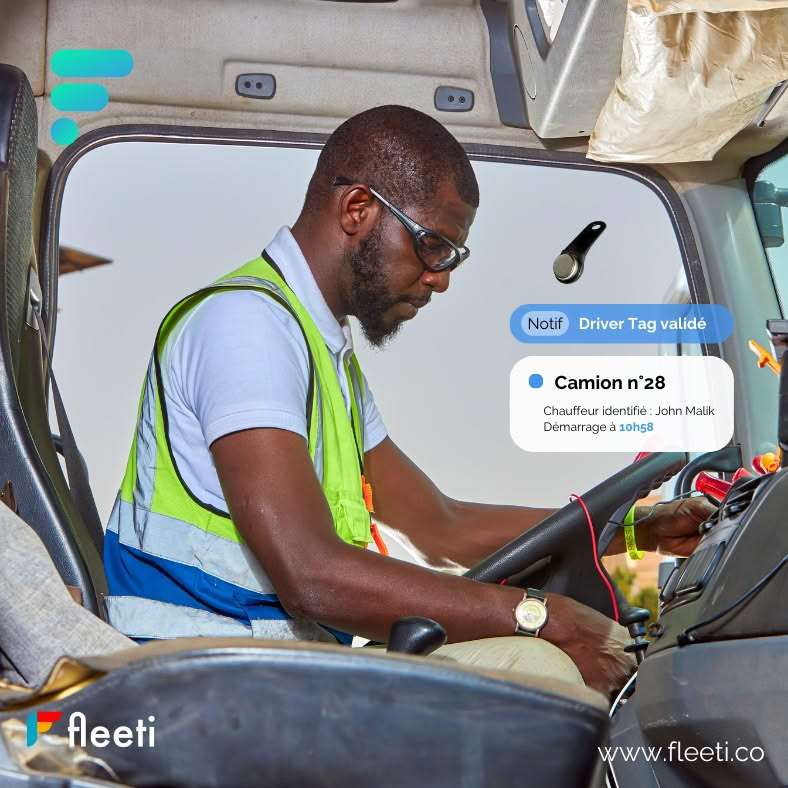
Do you know who is driving each of your vehicles, and how? For businesses, driver identification has become a priority for both safety and operational efficiency. Fleeti’s Driver Tag ensures that only authorised drivers get behind the wheel and keeps a complete history of every use.
This guide explains what a Driver Tag is, the problems it solves for Fleeti clients and the results seen in the field. It complements Fleeti’s driver management software.
What is a Driver Tag and how does driver identification work?
A Driver Tag is a driver identification badge: it tells the system who is getting behind the wheel of a fleet vehicle. Identification is instant and every use is recorded. The fleet manager therefore knows at all times who is driving which vehicle and can consult the full usage history.
Technically, the Driver Tag is a personal RFID badge that the driver presents at the start of the journey. On shared vehicles, Fleeti also allows identification via the mobile app, and connected vehicles can be automatically linked to their driver using telematics data.
At Fleeti, the Driver Tag works together with the Fleeti GPS tracker installed in the vehicle. The tracker reports journeys and driving data, while the badge shows who they should be attributed to. Combined with an immobiliser, the Driver Tag also becomes an anti-theft device.
What problems does driver identification solve?
Driver identification addresses three difficulties faced by Fleeti clients: unauthorised access to vehicles, the administrative workload involved in tracking users, and the fleet’s exposure to theft. The Driver Tag tackles them by linking every use of a vehicle to an identified, authorised driver.
How can you limit unauthorised access to vehicles?
To limit unauthorised access, the company defines the list of authorised drivers for each vehicle, then requires badge identification every time a vehicle is taken out. With the Driver Tag, Fleeti clients know instantly who is driving: every use is linked to an identified driver and, if an immobiliser is installed, the engine will not start without a recognised badge.
How can you lighten the administrative workload linked to drivers?
The Driver Tag feeds a reliable, searchable database of each vehicle’s usage. Administrative obligations become much simpler: less paperwork, fewer manual checks and valuable time saved. This history also helps you nominate the driver after receiving a traffic penalty notice.
Like vehicle tracking, driver identification involves processing employees’ personal data: they must be informed in advance of the purpose of the system. Our guide on the law governing employee tracking details these obligations.
How does the Driver Tag protect the fleet against theft?
Used together with a starter cut-off device, known as an immobiliser, the Driver Tag prevents the engine from starting if the driver’s identification has not been confirmed. This dual protection secures vehicles and reduces the risk of theft. To go further, also discover how to immobilise a vehicle or machine remotely.
What results does the Driver Tag deliver in the field?
In Mauritius, FedEx combined Fleeti GPS trackers with Driver Tags to gain better control over how its vehicles are used. The GPS trackers help it keep its fuel consumption and costs under control; the Driver Tags have enabled it to reduce the number of speeding incidents, for the safety of its drivers and other road users.
Rennel (FedEx) explains how the Driver Tags have helped optimise and transform the company’s operations in Mauritius:
Fleeti’s premium GPS trackers help us better control how our vehicles are used, particularly our fuel consumption and therefore our costs.
By combining these GPS trackers with Driver Tags, we have been able to analyse, control and therefore improve the use of our vehicles, especially the number of speeding incidents, ensuring the safety of our drivers and other road users.
Fleeti has a local team dedicated to fleet management in Mauritius. Linking each journey to an identified driver is also the basis for reliable driving behaviour analysis, driver by driver.
Why integrate driver identification into your fleet management?
Because tracking journeys and maintenance does not tell you who was behind the wheel. Driver identification links every use to an authorised person: it strengthens safety, reduces the administrative workload and protects vehicles against theft.
For more efficient, secure and optimised fleet management, the Fleeti fleet management platform brings together driver identification, telematics and fleet administration.
What is a Driver Tag used for in fleet management?
A Driver Tag is an RFID driver identification badge: each driver presents it before getting behind the wheel, making it possible to know who is driving each vehicle and to keep a history of every use. Combined with an immobiliser, it prevents the engine from starting without validated identification, which reduces the risk of theft and unauthorised access.