Guides
The 5 daily challenges facing fleet managers in Senegal and Côte d’Ivoire
In Africa, optimised fleet management has become a necessity for companies whose business relies on field operations.

Louise Duplaceau
Sales & Marketing Manager France
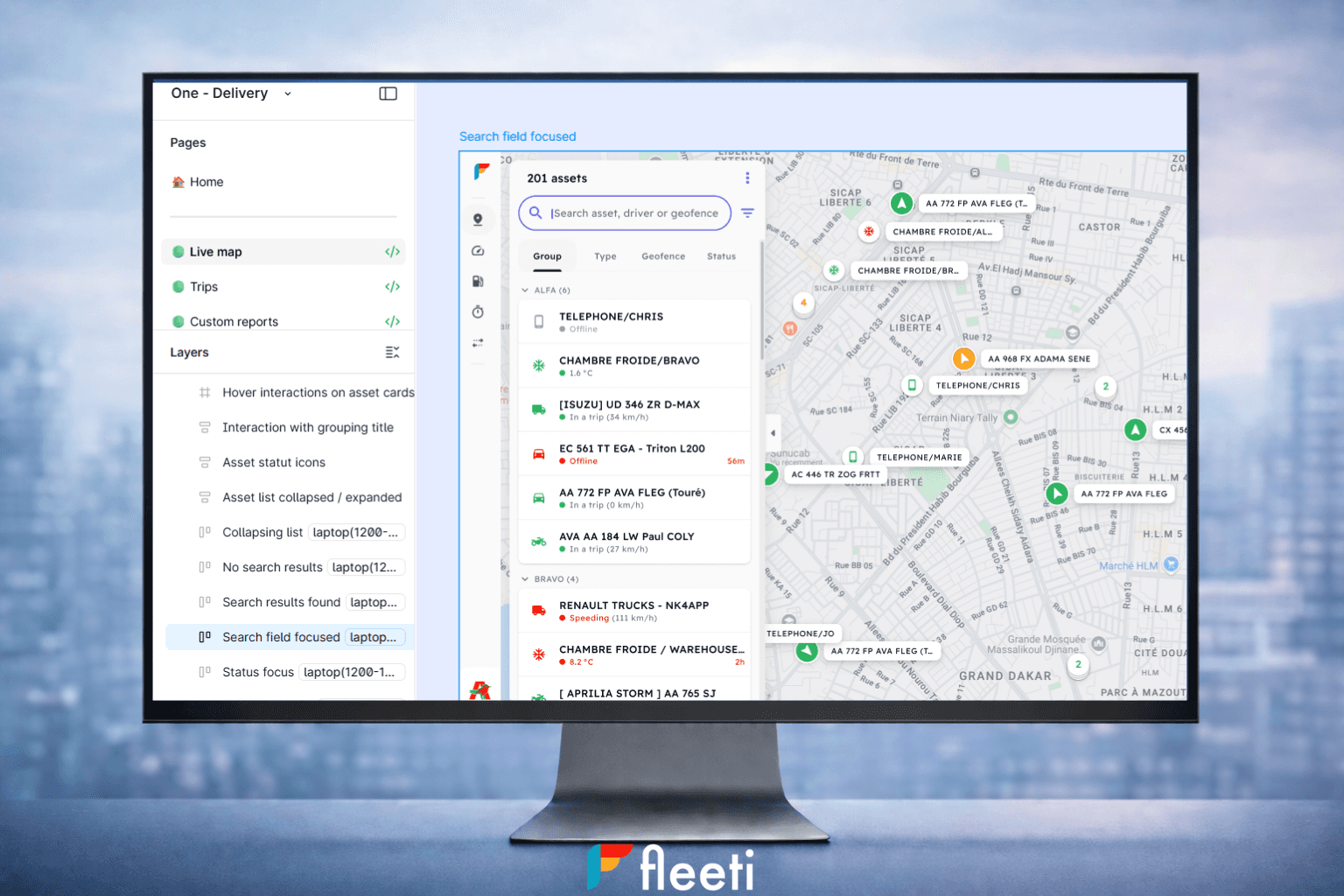



In Senegal as in Côte d’Ivoire, optimised fleet management has become a necessity for companies whose business relies on field operations. In Dakar, Abidjan and many operational zones, vehicles are no longer mere means of transport: they determine continuity of service, the safety of teams and economic performance.
For the fleet manager, daily life is often marked by complex trade-offs. Lack of visibility on vehicles, difficulty anticipating incidents, pressure on operating costs, stricter safety requirements or coordination of teams spread across several sites. These issues are reinforced by specific local realities: urban traffic density, long distances between sites, diversity of vehicle uses and operational constraints that are sometimes unpredictable.
The five major challenges facing fleet managers
In this article, we look back at the five major challenges facing fleet managers in Senegal and Côte d’Ivoire, and at the best practices that make it possible to meet them concretely.
1. Lack of visibility on real vehicle use
In Dakar as in Abidjan, many fleet managers lack a clear view of the daily use of their vehicles. Information often comes back partial, delayed or declarative. It then becomes hard to know where the vehicles really are, how they are used and whether they are deployed optimally.
This lack of visibility leads to gradual drift: needless detours, prolonged downtime, use outside the business context or difficulty reconstructing events in the event of an incident. In dense urban contexts or on multi-site operations, this opacity greatly complicates management.
Best practices: A first simple action is to formalise clear rules for vehicle use and make sure drivers understand them. Centralising journey information, even in a basic way, already makes it possible to identify recurring gaps.
When visibility is insufficient, GPS tracking becomes a structuring tool to objectify vehicle use and to base the fleet manager’s decisions on factual data rather than estimates.
In this context, GPS tracking solutions such as Fleeti Tracking give fleet managers in Senegal and Côte d’Ivoire continuous visibility of their vehicles, adapted to local realities on the ground.
“Before Fleeti, we had a partial view of our fleet. Today, thanks to real-time GPS tracking, we know exactly where our vehicles are and can react quickly.”
- Logistics manager, distribution company, Abidjan
2. Ensuring driver safety in the field
Driver safety is a major concern for companies operating in Dakar, Abidjan or on intercity routes. Complex traffic conditions, fatigue, operational pressure and risky behaviour increase the likelihood of accidents.
For the fleet manager, it is often hard to identify dangerous behaviour before an incident occurs. Prevention actions are then reactive, triggered after a claim, rather than preventive.
Best practices: The first step is to establish a safety culture, based on awareness rather than sanction. Holding regular meetings with drivers, reminding them of driving rules, analysing incidents collectively and setting up training sessions already helps reduce some risks.
Some companies in Côte d’Ivoire and Senegal rely on driving analysis and video telematics tools, such as Fleeti Vision, to better understand risk situations and put targeted prevention actions in place.
“With Fleeti, we were able to improve the safety of our fleet in Dakar. GPS and usage data as well as the Fleeti Vision tool help us raise drivers’ awareness in a constructive way.”
- Fleet manager, services company, Dakar
3. Controlling fleet operating costs
Fuel, maintenance, repairs, vehicle downtime: fleet costs are many and often diffuse. In Abidjan as in Dakar, the slightest drift can quickly affect operational performance, especially as vehicle numbers grow.
Without reliable data, it becomes hard to identify the items driving extra cost and to measure the real impact of corrective actions put in place.
Best practices: A first lever is to track fuel consumption regularly and match it to the real use of vehicles. Identifying the most expensive vehicles to run often makes it possible to target priorities quickly.
Putting in place preventive maintenance based on real use, rather than theoretical due dates, also helps reduce costs and limit unplanned downtime.
4. Coordinating multi-site and dispersed operations
Many companies operate simultaneously in Dakar, Abidjan and other regions. This geographic dispersion complicates the coordination of teams and the supervision of vehicles.
Best practices: Centralising fleet information, even at a basic level, is an essential first step.
A consolidated view also makes communication easier between field teams and operations managers.
Fleet management platforms such as Fleeti now make it possible to centralise vehicle data for operations spread across several countries or regions.
5. Turning data into operational decisions
Collecting data is not enough. Many fleet managers have information but struggle to use it operationally. The risk is then to produce dashboards that are little used or indicators disconnected from the field.
In Dakar as in Abidjan, the challenge is to turn data into concrete actions that are useful day to day.
Best practices: It is recommended to concentrate on a few key indicators that are genuinely useful for operational management. Sharing these indicators with the teams concerned creates a dynamic of continuous improvement.
Data must remain a decision-support tool, simple to understand and directly usable in the field.
Fleeti’s approach
Fleeti’s approach rests on a pragmatic use of vehicle data, designed to support fleet managers’ operational decisions. Our features are designed to meet the needs of companies in the field, offering you tools suited to your operational realities and making your day-to-day work easier.


